13th KAGRA International Workshop (KIW13)

Asia/Seoul
Lee-Yun Jae Hall, B101 (Yonsei University (Sinchon Campus))

Lee-Yun Jae Hall, B101

Yonsei University (Sinchon Campus)
50, Yonsei-ro, Seodaemun-gu, Seoul, Republic of Korea Lee-Yun Jae Hall, Yonsei University, Sinchon campus
Description

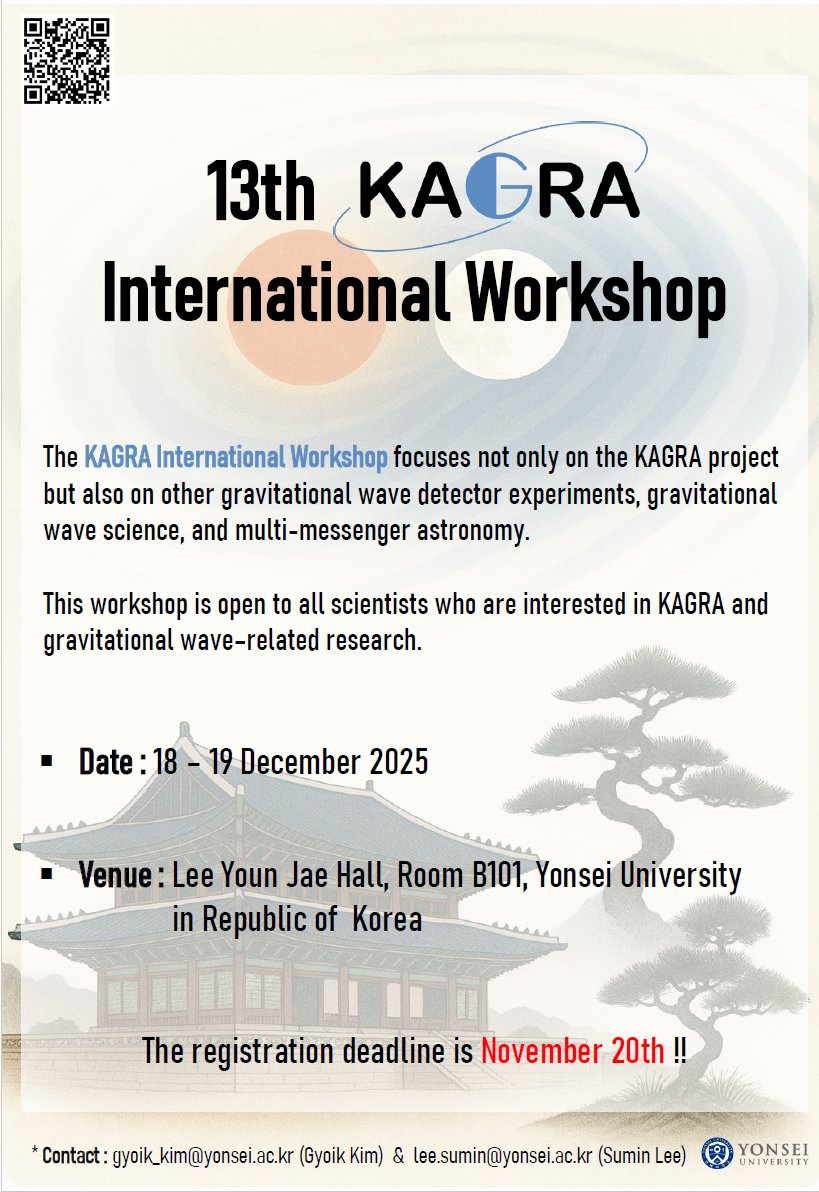
The 13 th KAGRA international workshop (KIW) will be held on 18-19 (+20) December 2025 in Yonsei University, Seoul, Korea.

 (The main schedule of KIW13 will take place on December 18–19. 
December 20 is reserved as a backup day; in case any additional or satellite meetings are arranged.)

The KAGRA International Workshop focuses not only on the KAGRA project but also on the other gravitational wave detector experiments, gravitational wave sciences, and multi-messenger astronomy.

This workshop is open to all scientists who are interested in KAGRA, gravitational wave-related research and multi-messenger astronomy.
  • The banquet is held in 18 December dinner.
  • We have a poster session.


  • K-ETA information

Travelers entering the Republic of Korea are generally required to obtain a K-ETA. Please visit this website to check whether you need a K-ETA.
https://www.k-eta.go.kr/portal/newapply/index.do?locale=EN

  • Visa support

Please check the visa support request at the registration form if you need the visa support.
Also, Please send email to the Sumin Lee (Yonsei Univ, LOC)(Email: lee.sumin@yonsei.ac.kr) if you need visa support.
We will give you a visa support via Department of Astronomy office.
Please visit this website to check whether you need a Visa. 

Republic of Korea Visa portal: https://www.visa.go.kr/

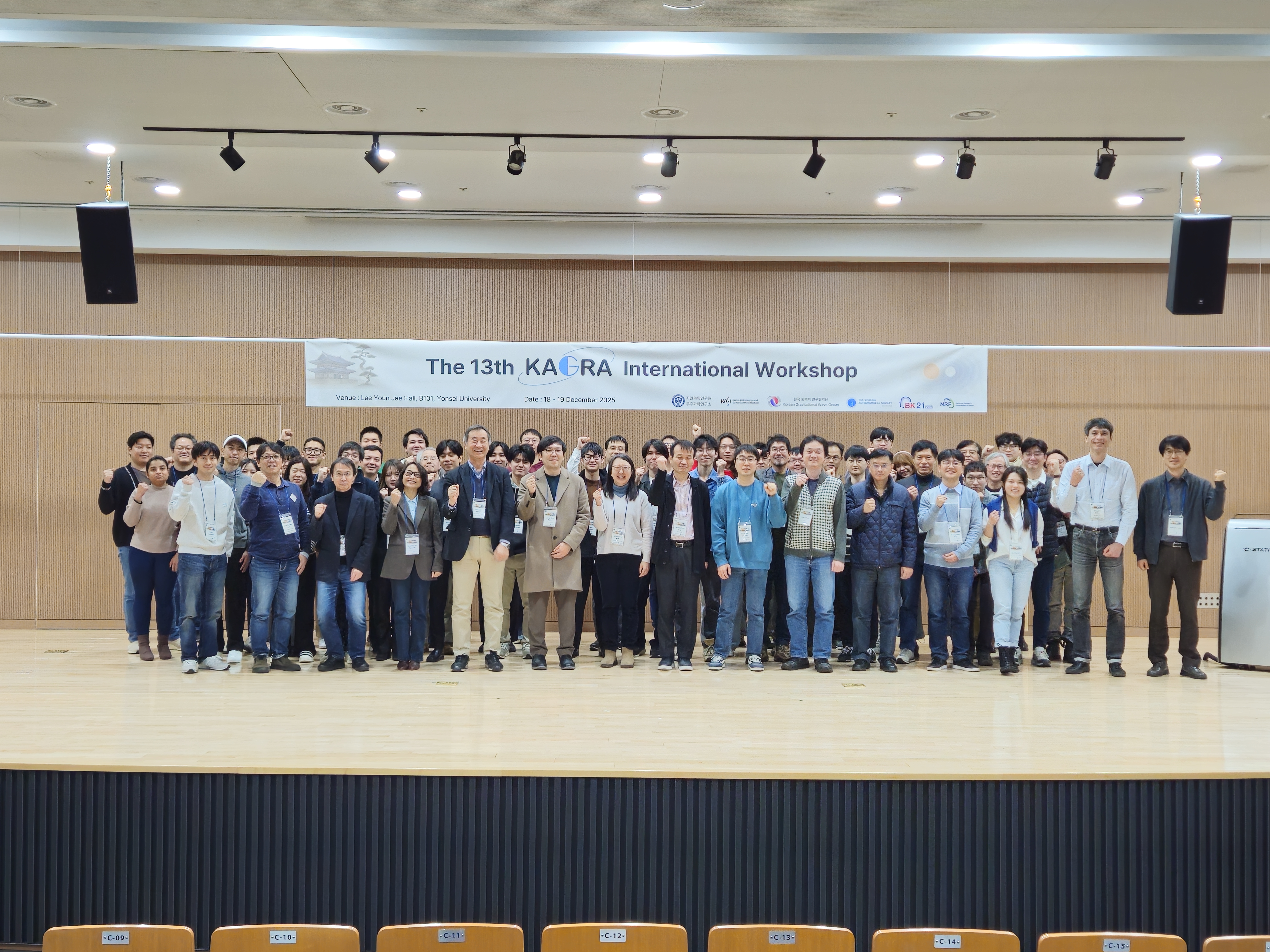
KIW 13 Photos

links : https://drive.google.com/drive/folders/1v9YRrnMyPgfEpeFaQTxtpstfJ0CxQ5Ei?usp=sharing
Local Organization Committee

  • June Gyu Park (Yonsei U.)
  • Gyoik Kim (Yonsei U.)
  • Sumin Lee (Yonsei U.)
  • Byeong Yun Yang (Yonsei U.)
  • Hojae Ahn (Kyung Hee U.)
  • Young-Min Kim (KASI)


Invited Speaker

  • Takaaki Kajita (ICRR, U. Tokyo)
  • Yeongbok Bae (Chungana U)
  • Seongjin Hong (Yonsei U)
  • Chul Chung (Yonsei U)
  • Ji Hoon Kim (Seoul National U.)
  • Gungwon Kang (Chungana U)
Participants
  • Andy Chen
  • Chia-Jui Chou
  • Chunglee Kim
  • Daiki Watarai
  • Dan Chen
  • David C.Y. Hui
  • Edwin J. Son
  • Gungwon Kang
  • Gyoik Kim
  • Hiroki Fujimoto
  • Hyun Song
  • Hyung Mok Lee
  • HyungWon Lee
  • John J. Oh
  • June Gyu Park
  • Keun-Young Kim
  • Marc Eisenmann
  • Quynh-Lan Nguyen
  • Sangin Kim
  • Seonjun Kwon
  • Shih-Hong Hsu
  • Shinji MIYOKI
  • Shu-Wei Yeh
  • Soojong Pak
  • SUNGHO LEE
  • Tai-Choon Yoon
  • Takaaki Kajita
  • Takafumi Ushiba
  • Takayuki TOMARU
  • Whansun Kim
  • Yi Yang
  • Yoichi Aso
  • Young-Min Kim
  • Yuto Ichinose
  • +32
  • Thursday, 18 December
    • Registration
    • Welcome remark
      • 1
        Welcome remark - Prof. June Gyu Park
        Speaker: June Gyu Park (Yonsei University)
      • 2
        Welcome remark - Prof. Yoo, Hwidong Associate Dean, College of Science
        Speaker: Hwidong Yoo (Yonsei University)
      • 3
        Welcome remark - Prof. Takaaki Kajita
        Speaker: Takaaki Kajita (ICRR, University of Tokyo)
    • GW Group Activity (30min * 3)
      • 4
        GWD activities in Korean GW group
        Speaker: June Gyu Park (Yonsei University)
      • 5
        Quantum teleportation frequency dependent squeezing experiment at Australian National University

        Frequency dependent squeezing using a 300 meter filter cavity is a well established technique for broadband quantum noise reduction in current gravitational wave detectors. However, in advanced detector configurations, more than one filter cavity is required. An alternative method uses EPR entanglement to achieve the required quantum noise response without the construction of extra vacuum envelopes. Quantum teleportation, an entanglement technique often used in quantum computing, is a protocol that can simulate two or more filter cavities, and in particular can be used to achieve frequency dependent squeezing for detuned GW detectors that exploit the optical spring effect. At the Australian National University, in collaboration with Japan-based GW researchers, we are aiming to demonstrate the required frequency dependent manipulation of quantum noise quadratures in a tabletop setting. This experiment is one representative of the ongoing collaboration between Australian and Japanese GW research groups under the ASPIRE program.

        Speaker: Michael Page (National Astronomical Observatory of Japan)
      • 6
        GW Universe Activity (TBA)
        Speaker: Hyung Mok Lee (Seoul National University)
    • 12:00
      Lunch Break
    • Gravitational Wave Science (20min *3)
      • 7
        A Bayesian View into Merger Jets: Multi-messenger Constraints from GW170817, GW190425, and Short GRB Observations

        The coincident observation of GW170817 and GRB170817A has provided unprecedented insight into the physical connection between binary neutron star mergers and short gamma-ray bursts. 
In this work, we perform a multi-messenger study with the aim of constraining the jet geometry of sGRBs, assuming that all BNS mergers produce relativistic jets. Our analysis incorporates gravitational-wave data from GW170817 and GW190425, together with the prompt and afterglow emission of GRB170817A. We also include the short-GRB detection rate from more than ten years of Swift monitoring to place constraints on the underlying BNS merger rate and jet structure.

        Speaker: En-Tzu Lin (National Tsing Hua University)
      • 8
        Gravitational Wave Signatures of Dark Matter-Admixed Neutron Stars
        Speaker: Quynh-Lan Nguyen (Phenikaa University)
      • 9
        Reducing Spin-Prior Bias in Population Inference of Binary Black Holes

        The LIGO-Virgo-KAGRA (LVK) collaboration has detected over 300 gravitational-wave events, mostly from binary black hole (BBH) mergers. These detections enable precise inference of BBH population properties such as masses, redshift, and spins. However, the conventional spin prior—uniform in spin magnitude and isotropic in orientation—assigns near-zero probability density near effective spin |Xeff| = 1 and precession spin Xp = 0, potentially biasing hierarchical Bayesian population inference in these regions due to limited posterior samples. We propose a new spin prior that is uniform in both the Xeff and Xp parameters, conditioned on mass ratio. Using simulated BBH populations, we compare parameter estimation and hierarchical inference results between the conventional and new priors. Our results show that populations concentrated in low-probability-density regions(e.g |Xeff| = 1, Xp = 0) cannot be reliably inferred with the conventional prior, while the new prior mitigates this bias.

        Speaker: Kazuya Kobayashi (Institute for Cosmic Ray Research, University of Tokyo)
    • 15:00
      Photo
    • 15:10
      Poster session
    • GWD Technology (30min *2, 20min *3)
      • 10
        Status and future plans of the KAGRA commissioning

        The gravitational-wave detector KAGRA concluded the observing run on 19 November (JST) and started the post O4c commissioning activities. During the observing run, KAGRA achieved a maximum sensitivity of 7.5 Mpc owing to the commissioning activity before and during the O4c observing run. In this talk, I will provide the KAGRA commissioning status and the future plans on the commissioning to further improvement of the sensitivity.

        Speaker: Takafumi Ushiba (ICRR, UTokyo)
      • 11
        Machine learning enhanced quantum state tomography on FPGA

        As a crucial diagnostic toolbox for applications with squeezed states, I will illustrate the implementation of our machine-learning (ML) enhanced quantum state tomography (QST) for continuous variables, through the experimentally measured data generated from squeezed vacuum states [1]. Then, I will demonstrate the deployment of ML-based QST onto edge devices, specifically utilizing Field-Programmable Gate Arrays (FPGAs) [2]. This implementation was realized using the ”Vitis AI” development environment provided by AMD Inc. The FPGA-based QST offers a highly efficient and precise tool for quantum noise reduction in advanced gravitational wave detectors.

        [1] Hsien-Yi Hsieh, et al., "Extract the Degradation Information in Squeezed States with Machine Learning," Phys. Rev. Lett. 128, 073604 (2022).
        [2] Hsun-Chung Wu, et al., "Machine learning enhanced quantum state tomography on a field-programmable gate array," APL Quantum 2, 026117 (2025); Cover; Featured Article; Scilight.

        Speaker: Ray-Kuang Lee (NTHU)
      • 12
        Distributed Quantum Sensing with Bright Twin Beams
        Speaker: Seongjin Hong (Yonsei University)
      • 13
        Development of an Active Mode-Matching Telescope in Korea
        Speaker: Sumin Lee (Yonsei University)
    • Banquet
  • Friday, 19 December
    • 10:00
      Morning Coffee break
    • Multi-messenger Astronomy & Cosmology (30min * 3)
      • 14
        TBA
        Speaker: Takaaki Kajita (ICRR, University of Tokyo)
      • 15
        Strong progenitor age bias in supernova cosmology
        Speaker: Chul Chung (Yonsei University)
      • 16
        Introduction to the 7-Dimensional Telescope: Eyes of Multi-Messenger Astronomy (Online)
        Speaker: Ji Hoon Kim (Seoul National University)
    • 11:50
      Lunch Break
    • GW burst pipline and matched filter (20min * 4)
      • 17
        GWAK's preparation for offline burst search

        Matched-filtering techniques are the standard approach for detecting compact binary coalescences (CBCs) and have been employed in all confirmed gravitational-wave (GW) detections to date. However, these methods rely on large banks of accurately modeled waveform templates, making them unsuitable for poorly modeled or unmodeled sources such as core-collapse supernovae (CCSN) and other unknown transient events. To address this limitation, several pipelines have explored waveform-agnostic approaches for gravitational-wave anomaly detection. In this work, we present GWAK2, an updated and improved version of our previous anomaly detection pipeline, Gravitational Wave Anomalous Knowledge (GWAK). GWAK2 introduces new training strategies and model orchestration techniques to enhance detection performance. The pipeline constructs a low-dimensional embedding space using a ResNet-based feature extractor and a normalizing flow model, enabling it to capture distinctive signal features and identify potential gravitational-wave events beyond the scope of modeled searches.

        Speaker: Andy Chen (National Yang Ming Chiao Tung University)
      • 18
        Building a novel pipeline for searching anomalous gravitational wave bursts

        By leveraging a high performance noise reduction algorithm and the bespoke deep-learning architectures developed by us, we are constructing a pipeline for searching anomalous gravitational wave bursts. The pipeline consists of three parts: BEACON, DeepGRAV and GenGRAV. I will introduce the basic concepts of this work in this talk.

        Speaker: David Hui (Chungnam National University)
      • 19
        Toward a Model-Agnostic Framework for Detecting Burst Transients

        In this talk, I will introduce the development of the unmodeled search pipeline BEACON. The pipeline has a block-wise structure that consists of four stages: denoising, anomaly clustering, significance evaluation, and coincidence analysis. We tested the framework on GWTC-1 BBH events and off-catalog BBH signals from the O2 run. With its efficient computation, the pipeline demonstrates low-latency performance, with the actual running time being less than 50% of the batch duration. This work has been submitted to Physical Review D.

        Speaker: Sangin Kim (Chungnam National University)
      • 20
        Optimizing Searches for Long-Duration Gravitational Waves from Low-Mass Compact Binary Coalescence

        I'll present a method to optimize the analysis of long-duration Gravitational Waves (GWs) from compact binary coalescences (CBCs). A typical example is GWs from compact objects with masses below that of the Sun. The LIGO–Virgo–KAGRA (LVK) collaboration, operating the world’s most sensitive GW observatories, searches for CBC signals in the 0.2–1.0 solar mass range, providing leading constraints on the abundance of Primordial Black Holes (PBHs).

        For such long-duration signals, sensitivity is limited by the computational cost of dense template banks and the memory requirements of the analysis. Current searches mitigate these challenges by increasing a low-frequency cutoff (e.g., 45 Hz), which reduces computational demands but sacrifices sensitivity. Our study indicates that incorporating lower-frequency data could improve PBH abundance limits by up to ~36%. Moreover, next-generation GW detectors will achieve greater sensitivity at low frequencies, inevitably increasing signal durations.

        To address these challenges, we propose a method that applies a heterodyne-like technique, enabling efficient exploration of long-duration waveforms. For a given target waveform, we generate a ratio with respect to a reference waveform. The resulting “ratio waveform” has a duration approximately equal to the difference between the two original durations, making it much more compact. This allows matched filtering to be performed on a shorter waveform while preserving the full sensitivity of the original signal.

        This approach substantially reduces both computational cost and memory usage, enabling the analysis of signals that would otherwise be prohibitive to search. Our method is directly applicable to current detectors and will be increasingly valuable for the low-frequency sensitivity of future GW observatories.

        Speaker: Yasuhiro Murakami (ICRR, UTokyo)
    • 14:50
      Break
    • GW and Astrophysics (30min * 2, 20min *3)
      • 21
        TBA
        Speaker: Seonjun Kwon (RESCEU, The University of Tokyo)
      • 22
        Research and Subtraction of the Noise in Gravitational Wave Data with Machine Learning
        Speaker: Chia-Jui Chou (ShanghaiTech University)
      • 23
        Deformation and Ringing of BH Horizon during Fly-by Encounters
        Speaker: Dr Yeong-Bok Bae (Chung-Ang University)
      • 24
        Features of non-merging ringdown radiations from hyperbolic encounters of two black holes

        Non-merging ringdown radiations have recently been discovered when two black holes closely encounter and fly-by away afterward. We present some features of such radiations for a wider space of the impact parameter and initial velocity characterizing hyperbolic encounters. Different patterns of gravitational radiations from the merging ones are also presented, focusing on the beaming effect due to the fast motions of constitute black holes.

        Speaker: Prof. Gungwon Kang (Chung-Ang University)
    • Closing remark
      Convener: June Gyu Park (Yonsei University)